How it works
How finasteride works
Male pattern baldness happens when hair follicles on the top of your head are sensitive to a hormone called DHT, which your body makes from testosterone. Most men are sensitive to some degree. Over time, DHT shrinks those follicles, so each new hair grows back a little finer and shorter than the last. Eventually the hair becomes too fine to see. That's why hair thins before it disappears.2
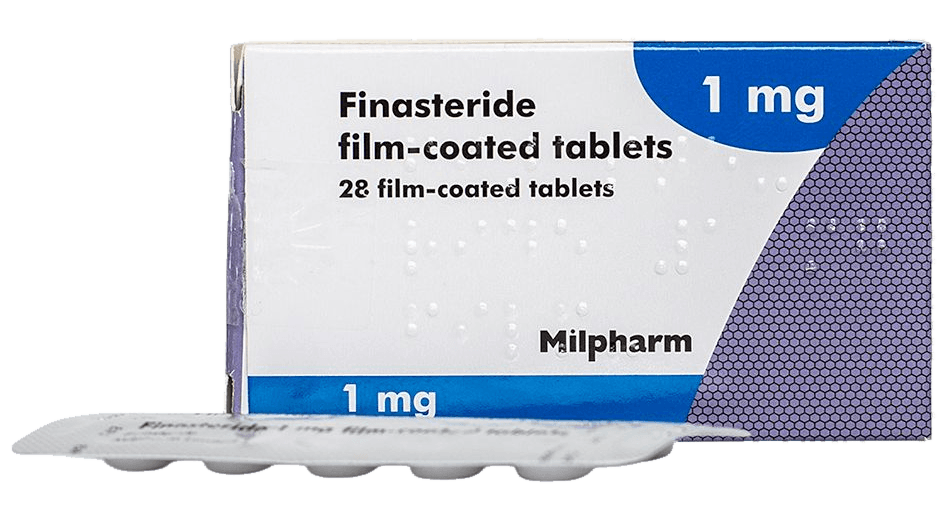
Finasteride blocks the enzyme that turns testosterone into DHT.1 At 1mg a day, it lowers DHT in the scalp by around two thirds. With less DHT, the follicles stop shrinking, and hairs that were thinning can recover some of their thickness.
What that means for you
For most men, finasteride stops hair loss from getting worse.13 Some men also see some regrowth, mostly at the crown and less at the hairline. It's far better at keeping hair than bringing it back, which is why starting early matters - the more hair you have, the more there is to keep. The trials behind the licence were in men aged 18 to 41 with mild to moderate hair loss, so the evidence is thinner for older men and for more advanced loss.13
Two common worries
Will it lower my testosterone? No. Finasteride reduces how much testosterone is converted into DHT, so testosterone levels can rise very slightly. It isn't known to affect your muscle, strength or energy.
Is finasteride a prostate drug? Finasteride is used for both, at very different doses. The 1mg tablet is licensed for hair loss. The 5mg tablet is a separate product for an enlarged prostate. If you're prescribed finasteride for hair loss, you'll be taking the 1mg dose.
When it isn't the right choice
Finasteride isn't for women or anyone under 18.1 It also won't help hair loss that isn't pattern loss. If your hair has started shedding suddenly from all over your head after an illness or a stressful few months, that's a different problem with a different solution. Read our hair shedding guide.
If you have smooth bald patches, or a scalp that's sore, red or inflamed, see your Ashford GP first. Read our scalp treatment guide.
What it can't do
Finasteride is good at holding on to the hair you have, but it won't rebuild a hairline that's already gone. If that's your main goal, read our guide to hair transplants in Ashford. Even after a transplant, treatment is usually recommended to protect the hair around it.
Not sure yet?
Take our free 2 minute assessment to check whether this is pattern hair loss and whether finasteride is the right next step.
Safety first
When extra care is needed
Finasteride is a well-understood medicine with very few interactions, but there are some situations where it isn't suitable or needs a conversation first. The clinician will ask about:
- Liver problems. Finasteride is processed by the liver, so if you've had liver disease or abnormal liver tests, tell the clinician.
- PSA tests. This one matters more than most sites let on. If you're in your forties or older, there's a fair chance you'll have a PSA test at some point. Finasteride lowers the PSA reading, so the result is usually doubled before it's interpreted.1 A result that looks "normal" could be hiding one that isn't, so you must tell whoever orders the test that you take finasteride, and they'll adjust for it.
- Giving blood. You shouldn't donate blood while taking finasteride, or for at least four weeks after your last tablet, because your blood could be given to a pregnant woman.4
- Allergy. Don't take it if you've reacted to finasteride or to any of the tablet ingredients before.
- Pregnancy. Women who are pregnant, or who could become pregnant, must not take finasteride. They must not handle crushed or broken tablets because the active ingredient can be absorbed through the skin and can affect the development of a male baby.1 Keep tablets in the pack, don't split them, and keep them well away from anyone who is or might be pregnant.
- Trying for a baby. If you and your partner are trying to conceive, or your partner is pregnant, talk to the prescriber. Tiny amounts of finasteride pass into semen. Current evidence doesn't show this causes harm, but it's a conversation worth having before you start rather than after. Reduced semen quality and infertility have also been reported in men taking finasteride, and these have generally improved after stopping.1
The clinician will also ask for a full list of your medicines. Finasteride has very few known interactions, but they'll check anyway.
Track your progress
Finasteride before and after photos
Most finasteride before and after photos online are taken under different lighting, with freshly styled hair, by someone with something to sell. We don't show them, because the only comparison that tells you anything is one of your own head.
For most men, a good result isn't dramatic regrowth. Instead, it's the crown and hairline looking much the same at month twelve as they did on day one, when without treatment the loss would have carried on. Some men also see the crown fill in. Either way, you'll only know if you have photos to compare.
How to take photos you can compare
Take two photos before your first tablet. Take one of your hairline from the front, with your hair pushed back so the temples are visible. Take the other of your crown from above. Ask someone to help, or use a mirror and your phone's timer. Use the same room, the same light and dry hair each time, and take them at a similar point after a haircut, because a fresh haircut can make hair look thinner. Repeat them at three, six and twelve months.
We'll remind you when it's time
At Ashford Hair Loss Clinic, we'll email you at three, six and twelve months with the two angles to take and a simple way to compare them side by side.
What to expect
How Ashford Hair Loss Clinic works
Assessment
Not sure what's causing your hair loss? Take our 2 minute assessment first. It works out whether your hair loss is pattern loss, shedding or something a GP should see, and gives you one clear next step.
Today
Clinician review
You'll complete an online consultation with our pharmacy partner, The Independent Pharmacy. A clinician checks that finasteride is right for you and can answer any questions. If it's prescribed, it arrives in plain packaging.
This week
Nothing visible yet
Some men report a little more shedding than usual in the first few weeks. If it happens, it tends to settle on its own. Don't judge anything yet.
Months 1 to 3
Shedding slows
The first sign it's working is less hair in the shower and on your pillow, not more hair on your head. If you're waiting for things to change in the mirror, it can feel like nothing is happening at month four. But keep going, it usually is.
Months 3 to 6
The first checkpoint
Compare new photos of your hairline and crown with your day one photos, taken in the same light. For most men, hair loss should have stopped getting worse.
Month 6
Most of the effect
Most of the regrowth you're going to get should be visible by now, mostly at the crown. In trials, some men kept improving into the second year.3 If your photos show no benefit at all by now, speak to The Independent Pharmacy about whether it's worth continuing. If you'd like to discuss whether to add minoxidil, contact them at any time.
Month 12
It works while you take it
If you stop, DHT rises again. The benefit starts to reverse by around six months, and by nine to twelve months your hair goes back to where it would have been without treatment.1 It won't be worse than if you'd never started, but it won't be protected either. If anything changes with your health or medicines, tell The Independent Pharmacy before your next order.
Ongoing
Adding minoxidil
Many men combine finasteride with topical minoxidil. It works differently, encouraging growth rather than blocking DHT, so the two may add to each other's effect. Topical minoxidil is available without a prescription, and The Independent Pharmacy can advise on whether it's worth adding. Learn about which hair loss treatments work well together.
No GP referral needed
Getting finasteride in Ashford
You don't need a GP referral or an appointment. The consultation is done online with our pharmacy partner, The Independent Pharmacy.
What the clinician will ask
The clinician will ask your age and general health, any medicines you take, whether you've had liver problems, whether you or your partner are trying to conceive, any history of low mood or depression,5 and what your hair loss looks like and how long it's been happening. It only takes a few minutes on your phone.
Why online rather than in person?
Male pattern hair loss is usually diagnosed from the pattern of loss and your history, not a hands-on scalp examination.2 If something does need to be checked in person, the assessment will send you to your GP instead. You may also consider a trichologist in Ashford for a scalp examination.
Don't buy it from a forum
Some men reading this are weighing finasteride from an overseas website, a group buy on a forum, or 5mg prostate tablets cut into quarters. Here's why we'd steer you away from all three:
- Counterfeit finasteride is sold online, and you can't tell by looking. You might be taking the right dose, the wrong dose, or nothing.
- Overseas pharmacies may not check whether it's right for you, so the pregnancy, PSA and mood conversations never happen.
- Quartering a 5mg tablet gives you uneven doses from a tablet that isn't designed to be cut, and creates exactly the crushed-tablet dust that the pregnancy warning highlights.
Any pharmacy registered with the General Pharmaceutical Council is fine, and you can check any of them on the GPhC register, including our partner. The generic finasteride on this page has the same active ingredient and the same dose as Propecia, and is licensed for the same use, at a fraction of the branded price.
Before you start
Important safety information
Everything on this page is a summary. It's always worth reading the patient information leaflet before starting treatment.
Finasteride side effects
Some men who reach this page have read something frightening about finasteride, so let's start with the actual figures. In the trials that licensed finasteride for hair loss, sexual side effects (reduced sex drive, difficulty getting or keeping an erection, reduced volume of ejaculate) were reported by roughly 4 in 100 men taking finasteride, and by roughly 2 in 100 men taking a placebo tablet with nothing in it.1 So the extra risk that comes from the drug itself is around 2 in 100, and for most of those men it settled either while continuing or after stopping. For some men it hasn't. Sexual side effects have been reported to continue after stopping finasteride.15 Nobody knows how often this happens, and you should weigh it up before you start.
What can happen
Uncommon side effects (each affecting up to 1 in 100 men, which is how they add up to the combined figure above) include reduced sex drive, difficulty getting or keeping an erection, problems with ejaculation including reduced volume, and low mood or depression.1 If you notice any sexual side effects, speak to the clinician at The Independent Pharmacy. They may advise you to stop. Sexual side effects can also affect your mood, so mention it if you're feeling low as well.
Side effects where the frequency isn't known include breast tenderness or enlargement, allergic reactions (rash, itching, swelling of the lips, face or throat, in which case seek urgent help), testicular pain, reduced semen quality and infertility, anxiety, suicidal thoughts, and sexual side effects that continue after stopping treatment.1
Report quickly any breast lump, pain or nipple discharge, because breast cancer has been reported in a small number of men taking finasteride.1 These need checking by your Ashford doctor.
Depression, anxiety and suicidal thoughts have also been reported in men taking finasteride. If you notice low mood, anxiety or any thoughts of harming yourself, stop taking finasteride and speak to a doctor straight away. Your pack includes a patient alert card that summarises these risks. Read it, keep it, and consider showing it to someone close to you, because they may notice a change in your mood before you do.15
How to take finasteride
Take one tablet, once a day, at roughly the same time each day. You can take it with or without food, it doesn't matter. Swallow it whole with water. Don't split, crush or chew the tablets, and don't handle broken ones anywhere near someone who is or might be pregnant. If you miss a dose, take the next one at the usual time, don't take two to catch up. Keep it in the original pack, out of reach of children and away from anyone pregnant. It works only while you keep taking it, so build it into something you already do in your daily routine.
Finasteride in Ashford FAQs
The strongest evidence for finasteride is at the crown and the top of the scalp. It may slow a receding hairline, but its effect at the temples is less well established, and regrowth there is uncommon. If your hairline has already gone back a long way, finasteride won't bring it back. Only surgery brings back what's gone, and finasteride is usually recommended afterwards to protect the result.
Typically, you'll experience less shedding by three to six months, with loss stopping by month six, and most of the regrowth is visible by twelve months. Judge it by comparing photos, not by looking in the mirror, and don't judge results before month six.
Men have taken finasteride continuously for decades. It's been prescribed for hair loss since the late 1990s and for prostate conditions at a higher dose for longer. Side effects, where they happen, usually appear early rather than late. That isn't the whole picture, though. Sexual side effects have been reported to continue after stopping in some men, and depression and suicidal thoughts have been reported during treatment. These are the reasons the clinician asks about your mood before prescribing, and why you should seek advice if your mood or sexual function changes.
Finasteride doesn't lower testosterone. If anything it slightly raises it, because less is being converted to DHT. It isn't known to affect muscle, strength or recovery. On fertility, reduced semen volume, reduced semen quality and infertility have been reported in a small number of men, and these have generally improved after stopping. If you're trying for a baby the prescriber will want to talk it through.
Both lower DHT, and dutasteride lowers it further. In the UK, dutasteride is licensed for an enlarged prostate but not for hair loss, so using it for hair loss is off-label. Finasteride 1mg is the licensed option and the usual place to start.
Topical finasteride is a solution or spray applied to the scalp. It isn't available as a licensed product in the UK, and the evidence for it is smaller than for the tablet. Some finasteride is still absorbed into the body, so the same cautions apply.
Finasteride isn't prescribed on the NHS for hair loss, so it's only available privately. Your Ashford GP could write a private prescription, but you don't need to see them to get one. Through our pharmacy partner, a prescribing clinician reviews your full consultation online and checks it's right for you, with no referral needed.
Finasteride 1mg costs £13.89 for 28 tablets through our pharmacy partner, with discreet delivery. The consultation is included.
About the author

Andy Boysan
BPharm (Hons) · GPhC Registered Pharmacist
Andy Boysan is a GPhC-registered pharmacist and co-founder of The Independent Pharmacy, with over 30 years’ experience across community pharmacy and specialist settings. His expertise covers clinical governance and regulatory compliance, patient safety and quality improvement, and medicines management and optimisation.
Andy graduated from the University of Bath in 1997 with a BPharm (Hons) in Pharmacy. He has held senior leadership roles managing individual pharmacies, clusters and wider regions for major national chains, with responsibility for performance, regulatory compliance and standards of patient care.
He now leads the clinical and operational strategy at The Independent Pharmacy, overseeing regulatory compliance and ensuring the pharmacy operates to high standards of quality and governance.
- Professional registration
- GPhC 2047716 (General Pharmaceutical Council)
- BPharm (Hons), University of Bath
Medically reviewed
This page was last medically reviewed by Andy Boysan on .

Andy Boysan
BPharm (Hons) · GPhC Registered Pharmacist
Ashford Hair Loss Clinic is committed to providing clear, accurate and evidence-based information about hair loss, hair thinning, scalp conditions and their treatment.
Our content is reviewed at least every 12 months to reflect current UK clinical guidance. All treatment pathways described on this website are subject to individual clinical assessment and review.
Read our editorial policy to see how our content is written, reviewed and kept up to date.
